The Adjoint--Petrov Galerkin Method for Non-linear Model Reduction
Abstract
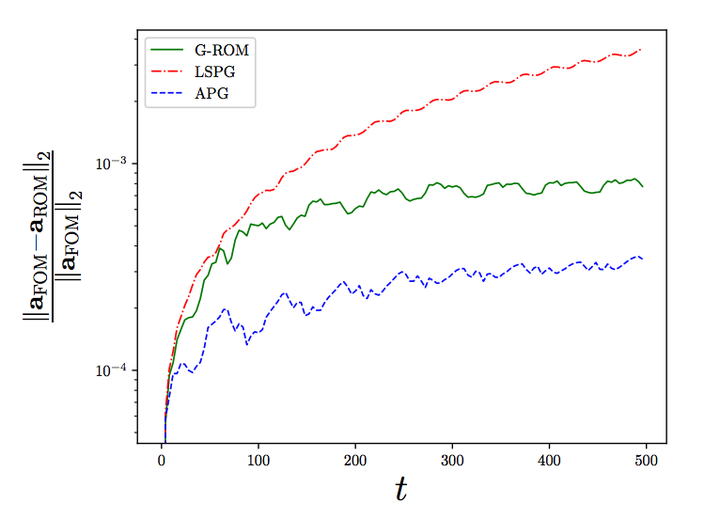
We formulate a new projection-based reduced-ordered modeling technique for non-linear dynamical systems. The proposed technique, which we refer to as the Adjoint Petrov-Galerkin (APG) method, is derived by decomposing the generalized coordinates of a dynamical system into a resolved coarse-scale set and an unresolved fine-scale set. A Markovian finite memory assumption within the Mori-Zwanzig formalism is then used to develop a reduced-order representation of the coarse-scales. This procedure leads to a closed reduced-order model that displays commonalities with the adjoint stabilization method used in finite elements. The formulation is shown to be equivalent to a Petrov-Galerkin method with a non-linear, time-varying test basis, thus sharing some similarities with the least-squares Petrov-Galerkin method. Theoretical analysis examining a priori error bounds and computational cost is presented. Numerical experiments on the compressible Navier-Stokes equations demonstrate that the proposed method can lead to improvements in numerical accuracy, robustness, and computational efficiency over the Galerkin method on problems of practical interest. Improvements in numerical accuracy and computational efficiency over the least-squares Petrov-Galerkin method are observed in most cases.

Eric Parish
Senior member of technical staff
Eric is a research staff member at Sandia National Laboratories. Previously, Eric was a John von Neumann postdoctoral fellow at Sandia, and before that he earned his Ph.D. from the University of Michigan in Aerospace Engineering. Eric’s research focuses on the development of engineering technologies that enable rapid simulation of complex multiscale and multiphysics systems through computational engineering, applied math, and machine learning. He is particulaly interested in reduced-order modeling, numerical methods for PDEs, scientific machine learning, and computational fluid dynamics.